
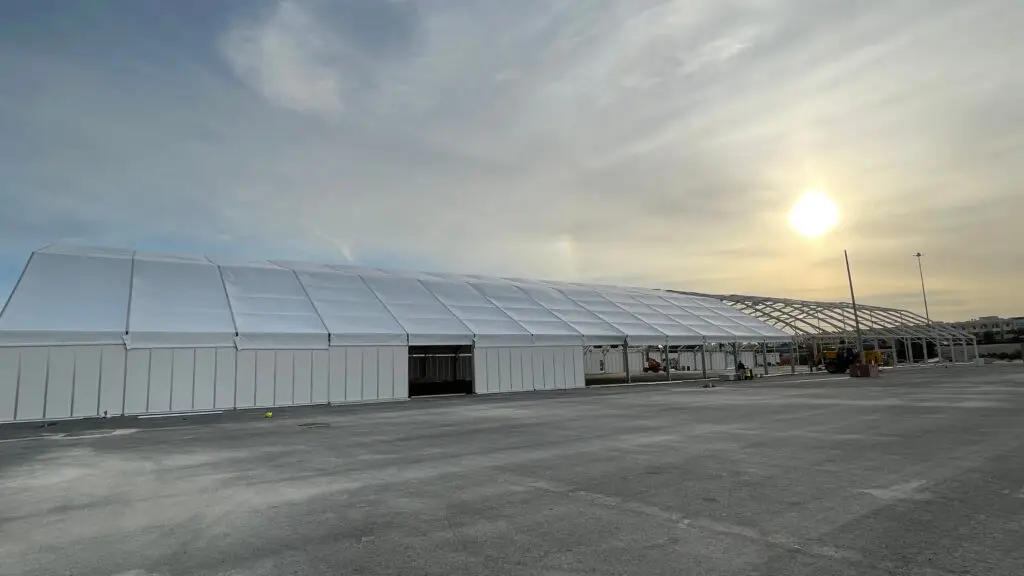
Choose temporary for needs measured in days to months, semi-permanent for one to fifteen years or an uncertain future, and permanent only when location, use and demand are certain for decades. Five questions decide it: how long, how certain, how fast, what performance, and where capital works hardest.
Most organisations frame the space decision as "build or make do." That framing hides the option that most often wins on the numbers. Here is the full field, and a framework for choosing between them.
The three categories, side by side
| Factor | Temporary (hire) | Semi-permanent | Permanent construction |
|---|---|---|---|
| Typical duration | Days – months | 1 – 15+ years | 25+ years |
| Time to operational | Days | Weeks | 12 – 36 months |
| Ownership | Rented | Owned asset (or long-term hire) | Owned, fixed to land |
| Engineering | Event-grade | AS 1170, council approved | Full NCC building |
| Fit-out & services | Basic | Full — HVAC, power, lining, glazing | Full |
| Adaptability | High (but not yours) | Expandable, relocatable, resellable | None — fixed |
| Capital profile | Opex, recurring | Moderate capex, residual value | Heavy capex, sunk |
| Exit cost | Nil | Dismantle & redeploy | Demolition or divestment |
Question 1 — How long will you need the space?
Under about twelve months, hire usually wins: no capital, no approval footprint, gone when the season ends. Beyond that, recurring hire fees start buying nothing — the crossover economics are detailed in hire vs buy. Past roughly fifteen years of certain, unchanging demand, permanent construction begins to justify its lead time and cost.
Question 2 — How certain is that answer?
This is the question that catches people. Permanent construction prices in certainty: commit the wrong footprint to the wrong site and the error is structural. If demand could double, halve, or move — a lease under negotiation, a contract up for renewal, a master plan in flux — the ability to extend, shrink or relocate a semi-permanent structure is worth real money, because it converts a forecasting problem into an operational adjustment.
Question 3 — How fast must it be operational?
Conventional construction runs 12–36 months from business case to occupation. An engineered semi-permanent structure is typically operational in weeks from approval, because components are manufactured off site and assembled on prepared ground. When the space need has a date attached — a season, a contract start, a renovation program — that difference usually decides the category.
Question 4 — What must the space actually do?
Match the specification to the duty, not the category to the stereotype. Racking, forklifts and conditioned storage need engineered floors, height and services — comfortably within semi-permanent capability (see specifications: spans to 50 m+, walls to 10 m+, full fit-out). Premium hospitality needs glass, climate and finish — also within reach, up to three storeys. What genuinely demands permanent construction is narrower than assumed: deep foundations for heavy fixed plant, complex multi-level cores, or statutory classes that require conventional buildings.
Question 5 — Where does capital work hardest?
A permanent build sinks capital into land improvement. A semi-permanent structure costs a fraction per square metre, is depreciable plant in many treatments, holds residual value, and can be redeployed — which means the capital saved stays in inventory, equipment or growth. For the actual numbers, see the Australian cost guide.
The short version
- Days to months, then gone: hire temporary.
- A year to fifteen, or an uncertain future: semi-permanent — speed of temporary, performance of permanent, and the only category that adapts.
- Decades of certainty on one site: build permanent, and accept the lead time.